|
 |












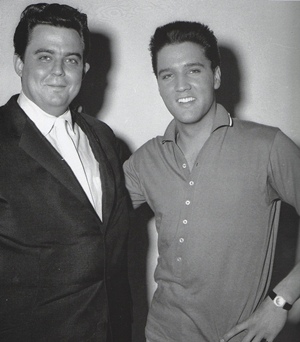
EIN note: Lamar Fike is currently working on his life story...all the great and funny things that have happened to him throughout the years. This will be a good one! This interview was conducted in 2005 Introduction by Lamar Fike:
Quote: "We got more ass than a toilet seat...and we were the key to the city." - Lamar Fike in "The Elvis Mob"
EIN: Lamar, you recently had a major health scare involving cancer. Please tell us about it and how you are now. LF: In April this year I was diagnosed with Non-Hodgkins lymphoma and started treatment the next day. Non-Hodgkins lymphoma is a rare malignant tumourand one that apparently tends to affect people in their middle years. I went through extensive chemo treatments and radiation on my knees. I was declared to be in remission in July. l'm still doing maintenance but feeling well. I believe it's a case of me getting on with business.
EIN: What is Lamar Fike doing in 2005?
LF: Working on staying well and representing a major historical memorabilia collector. The collector is a very good friend of mine and he is very astute. He owns items such as Eisenhower's Sword and also has a handwritten letter written by Elvis. I have seen the letter and it is genuine. It is similar to the letter Wayne Newton bought and wrote a song about. Elvis wrote it in a desolate moment. It's a sad but true thing.
EIN: Are you currently involved in any Elvis related projects?
LF: Yes our newly released book Elvis And The Memphis Mafia. It is available in Australia and the entire UK and will be available in the US in the spring.
EIN: You have referred to yourself as "smart answer Lamar" and in Elvis and the Memphis Mafia you call yourself a "character". Tell us more.
LF: I don't recall calling myself smart answer, as for the character that is other people's perception.
EIN: What was your primary role in the Memphis Mafia?
LF: Being there.
EIN: You were with Elvis from early 1957. What do you recall about those early times? LF: It was an incredible experience. In 1957 everybody wanted to see Elvis because he was such a phenomenon. They were interesting times watching Elvis grow and his effect on people. He really brought music to young people. Previously music had been the domain of the older generation and their heroes were people like Frank Sinatra, Tony Bennett, Doris Day. Elvis became the face of rock & roll and brought it into the mainstream. He opened the door for those who followed...The Beatles, The Rolling Stones etc. He was a cultural icon, one of the biggest cultural icons of the 20th century.
EIN: You ended your association with radio station KEBE in Jacksonville in a very unusual way. What was it? LF: After about 4 months I'd had enough. I remember it was a Sunday afternoon. I put an LP on, locked the door and drove out of town. I could hear the record going "click, click, click" as I drove out of town . That was my way of signing off.
EIN: By 1957 Elvis was the biggest star since Sinatra. In EAPRMM you state that Elvis didn't like being around other stars but you loved it. Who were some of your favorite stars who you met?
LF: Robert Mitchum, John Wayne, Danny Kaye, Yul Brynner. I grew up watching and admiring them in films and they were my heroes. Then suddenly one day I am standing next to them. It was a great thrill. They were all great people. I became good friends with Yul Brynner. I remember when I met John Wayne, I told him I thought he had won World War II single-handedly.
EIN: Elvis fired you and Alan Fortas in January 1958 after a squabble over a game of badminton. What happened?
LF: It was Cliff Gleaves not Alan but that was just one of the 2100 times Elvis fired me over the years. You have to understand that there was a lot of pressure on us and Elvis at the time. There were issues for him about his tax status. For all of us, we'd spend three months at a time at Graceland snapping at each other. One day Cliff and I got into a fight and Elvis decided that he couldn't just sack one us, so he sacked us both. But it didn't last long before we were re-hired.
EIN: Many biographies say Elvis was just a regular G.I. while stationed in Germany. However, there isn't anything ordinary about being accompanied by your family and entourage and living off-base. How did the Army react to this situation?
LF: It was his father, grandmother and just Red and I. The army allowed it. The other GI's accepted Elvis and treated him as an equal. While he may have been a major star and a millionaire. like them he was being paid $78 a month and doing everything they had to do. At the time it was also not unusual for other GI's to bring their wives with them to Germany. Red and I didn't have any money most of the time we were there. Every day Vernon would give us two marks a piece. It wasn't much back then and if we wanted to go out and have a drink while Elvis was out on maneuvers, we'd have a tough time. Elvis thought we were OK financially but that was because he didn't know how much anything cost. However, he knew a mark was only worth about a quarter and that you couldn't buy much with that. Vernon wasn't happy but Elvis told him to increase our money to 200 marks a week. EIN: How did Elvis adjust to largely being out of the US media spotlight while in Germany?
LF: It was difficult at first but then he got used to it. There were still a lot of photographers trying to get his picture and he was always being asked for interviews. It was just wanted on the same scale as it had been back in the US.
EIN: Lamar, what are your fondest memories of being in Germany with Elvis?
LF: The girls!!! EIN: And? LF: The girls!!!!!! EIN: Germany was also the start of the "chemical friends". What can you tell us about the pills and their impact on Elvis and your life?
LF: Elvis took them. It started around 1957. As I said in "Revelations of the Memphis Mafia" Elvis was taking amphetamines ("uppers". He got them from his mother. You got such a high from them you wanted more. At the time Gladys couldn't work out why she was taking so many pills. It was actually Elvis swiping them. I tried them and boy I wanted to stay on that elevator for a while! Because I lived at Graceland I saw a lot more than some of the guys.
EIN: Lamar, you were the first member of the MM to live at Graceland. After you moved in how did life at Graceland change during the next few years? LF: Everything was happening so fast that we just lived it to the best of our abilities. And we always lived life to the fullest. EIN: Tell us about the 'Bluebell Girls' in France.
LF: They were dancers at the Lido and they were everything you would hope they would be. They were all from England. They were enthralled with Elvis and I guess some of use were enthralled by them. That is a very fond memory.
EIN:Lamar, you and Freddy Bienstock were known as being 'song pluggers' for song publishing company, Hill & Range. What was your connection with Hill & Range? LF: I ran their Nashville Office. I was with them from 1963 to 1972. At the same time I gathered material for Elvis from my Nashville writers. It was an exciting time and I was glad to be able to contribute to Elvis' musical recordings while at the same time maintain my independence from him through my job. I was making around $50,000 a year which was a lot of money at the time.
You'll often see Hill & Range criticized for what it did with Elvis but overall I think it served him him well. As an aside I remember in Revelations of the Memphis Mafia my good friend Marty Lacker was critical of Hill & Range. I liked my response to that: "Good God! Marty blames Hill and Range for Elvis's whole demise! That's bullshit. I saw a lot of those pill bottles, let me tell you. And not one said "Hill and Range" on it." EIN: What are some of your favorite Hill & Range tracks that Elvis recorded?
LF: 'Kentucky Rain' and 'Indescribably Blue' to name a couple. It was good to be able to contribute to Elvis' creative part. Kentucky Rainj became his 50th gold record and another million seller.
EIN: Roots, family and structure were very important to Elvis, and the MM functioned in many ways as an extended family. How did Elvis structure the MM so it worked as well as it could?
LF: He picked people he could trust and who he liked and then we took care of the rest ourselves.
EIN: The Memphis Mafia was an "exclusive club" where Elvis picked the members. What were the essential personal qualities or elements that allowed entrance to the MM?
LF: Trust, loyalty and that you could keep a secret. EIN: The Hollywood years. You guys had some real wild times. What are some of your recollections of that time?
LF: Making the movies were boring. We met some nice people and the peripheral activity was amazing. Initially he wasn't as boring for Elvis as he was involved in the filming. For the rest of us it became quite boring at times as we sat around. I used to wander onto other sets and meet other stars and production personnel. As for the peripheral activity what can I say that you wouldn't be able to figure out.
EIN: Lamar, Elvis' film career. It is well documented how Elvis came to loathe making many of his movies. There was an attempt to change the direction of his film career in the late 1960s through films such as Live A Little, Love A Little (sex farce); The Trouble With Girls (period drama); Charro (spaghetti western), and Change of Habit (contemporary social drama). Did Elvis see this change or was it the case he was just too "pissed off" with that part of his career to really care? LF: During the last few years of making the movies Elvis was pissed off with them but unfortunately he didn't do anything about it. After so many years of bad movies he needed a major change in the direction of his career. His return to live performing was just the jolt he needed at that time but sadly it too became repetitive and Elvis quickly became bored again. With his personality he needed ongoing creative stimulation.
EIN:Elvis and the issue of 'trust'. In 'The Elvis Mob' you made some interesting comments on this issue. Can you share them with our readers.
LF: It was an unspoken word but he expected it and he received it. I said in 'Revelations of the Memphis Mafia' that Elvis demanded special attention. We had to guard against treating him like one of the guys or else, all of a sudden, he'd throw it up at you. Elvis would say, "No, that shit stops there. He had to be the center of attention."
EIN: How insecure was Elvis as a person? LF: You had to know him to realize that but to answer your question he was, but then again, who wasn't.
EIN: As his fame grew, did his insecurity change in any way?
LF: Yes. Insecurity is really a catch-all. You can be insecure when you are earning $100 a month and then when you're suddenly earning $2 million a year you have a different kind of insecurity. Elvis was no different to most people. He was insecure about some things and not others. EIN: Elvis was very generous with material things. How difficult was it for him to share his inner feelings?
LF: Not to some of us. As I said earlier, trust was very important to Elvis and if he reallytrusted you he could open up to you.
EIN: Did you ever feel the wrath of Elvis' infamous temper?
LF: Pick a date and time. You have to understand that Elvis didn't find it easy to open up to a lot of people. In effect we became his "buffer zone". As he knew us well and was comfortable with us, Elvis could take out his frustrations on us and then get on with things. Those that don't have a "buffer zone" usually get into a lot of trouble. But Elvis' temper didn't last long. All was forgotten and forgiven quickly.
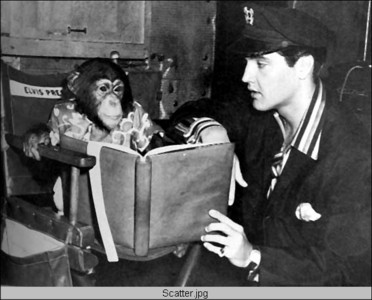
EIN: Most fans are familiar with Elvis' pet chimp, Scatter. Before Scatter, Elvis owned a spider monkey named Jayhew. What do you recall about Jayhew?
LF: That he was always hanging from something. I'm not sure what ever happened to Jayhew but he was later replaced by Scatter, who was a real rascal.
There was an incident I mentioned in "Revelations of the Memphis Mafia" about when we were in Arizona, I think. There was a Mexican maid knocking on our hotel room door. She came in and starting making up the room which was quite dark at the time. Well Scatter was there and he just lunged at her and latched on. She didn't know what had hit her and she let out the most blood-curdling scream you've ever heard. She came running out of the room with Scatter wrapped around her like a boa constrictor. He'd jumped on her back, put his legs around her waist and his hands over her eyes so she couldn't see. It was just so damn funny, not, of course, that she saw it that way. Anyway, we managed to get Scatter off her and the next minute he bolted and scrambled up a drainpipe onto the roof. He only came down when he saw us start to drive away in the car. EIN: Elvis and Priscilla...the marriage. The Colonel deliberately excluded many of the MM from the guest list. This must have hurt. What was your reaction at the time?
LF: Having been with Elvis for so long and part of his inner circle, I was very pissed off at not being told.
EIN: Why didn't Elvis and Ann-Margret work out as they seemed very compatible?
LF: They were both very competitive. Ann wanted her own career and Elvis was a traditional, old fashioned Southern gentleman. He wanted his wife to be at home. I said in "Revelations of the Memphis Mafia" that I thought Elvis would have married Ann-Margret in a New York second if she was prepared to quit show business. But that wasn't going to happen and Ann went on to be a big star. Also, Elvis had to stop seeing her when he was forced to marry Priscilla. EIN: Forced to marry Priscilla? LF: Yes, Priscilla's father "called in the numbers" on their relationship. Elvis told a few of us this. Priscilla's father denies it but that's what Elvis told us. Elvis always wanted to have a son so this was also at least one important reason why he agreed to the marriage. EIN: I believe Elvis considered selling Graceland shortly after he bought the Circle G ranch. Is this true?LF: Not really. He did get it briefly in his mind to sell Graceland and re-locate. He said to me, "Lamar, I'm tired of all this. I want to move out." But his desire to do so was shortlived.
EIN: Elvis' relationship with 14-year-old Priscilla. You had a strong reaction. Please tell us how you felt about the relationship. LF: When I found out their relationship was more than just necking I was afraid we were all going to prison without a trial. Elvis told me he had the whole thing in control. I said "I hope you do. Otherwise, they'll ship us home in a goddam cage!" EIN:Lamar, how did membership of the MM affect your marriage/relationships? LF: It made it difficult at times just having to spend the time with Elvis but that was my choice. We all make choices throughout our life and that was one of mine. There are consequences...and these can be good and bad. EIN: In Elvis Aaron Presley: Revelations of the Memphis Mafia (EAPRMM), which was recently re-issued as Elvis and the Memphis Mafia, you talk about the pills and Elvis' "self-mutilations". Many fans won't be aware of this issue. What can you tell us?
LF: The self mutilation thing has been blown out of proportion. Elvis did do things like pulling out his ingrown toenail. It was a stunt. It would get infected and he'd get whatever doctor was around to give him Dilaudid, an opiate. But as I say, the whole self-mutilation thing has been blown way out of proportion.
In Part 2 of our interview, Lamar discusses the Comeback years, the night Lamar and the Colonel surprised Elvis live on stage wearing Santa Claus outfits, Elvis' physical and emotional decline, and why Elvis' legacy will endure. He also tells us what he thinks of many of the people in Elvis' life and there is a great quote from him about actress Nicole Kidman.
Interview by Nigel Patterson. Click here to comment on this article
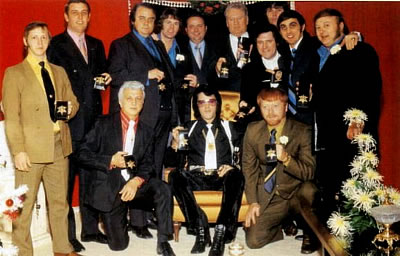
Click to view the "Memphis Mafia" website "Bright lights city moved their soul.... They strode into town With a swagger and ready fist, Protecting the people's King Good ole boys, one and all, Flashy badges and an orgy of excess, Their life was for living Hard, fast and fun, Fighters and lovers With a "downhome" cheeky grin, If you were looking for TROUBLE You'd come to the right place... Be prepared... As they'd "scatter" you all over the place"
(from "The Ballad of the Memphis Mafia", anonymous, 2003) Lamar Fike was interviewed in December 2005 by EIN's Nigel Patterson. The interview was conducted both by telephone and email. EIN Website content © Copyright the Elvis Information Network.
Elvis Presley, Elvis and Graceland are trademarks of Elvis Presley Enterprises. The Elvis Information Network has been running since 1986 and is an EPE officially recognised Elvis fan club.
|
|