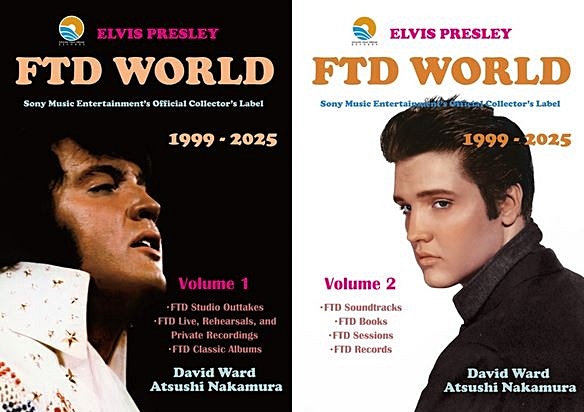
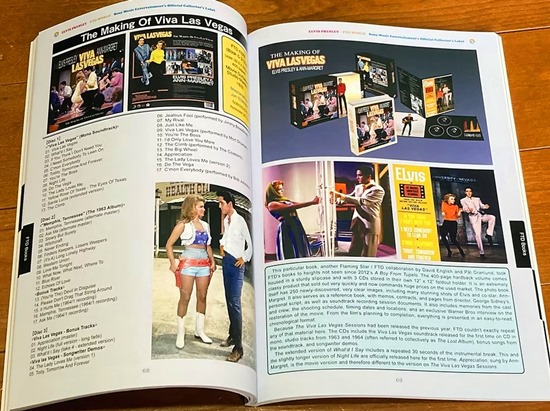
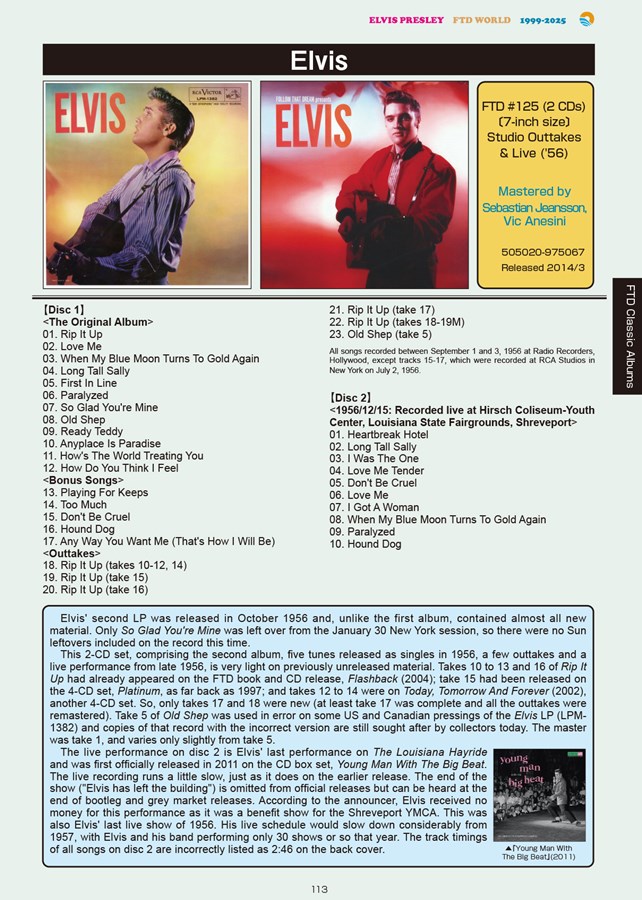
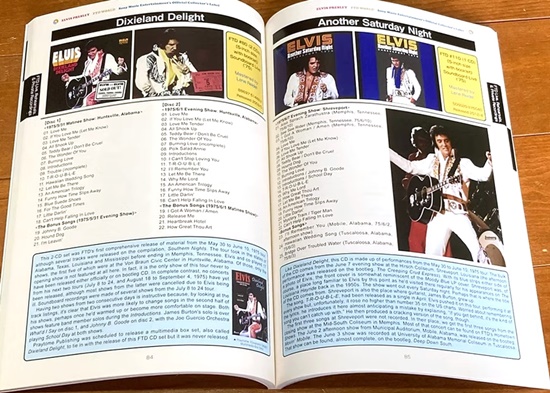
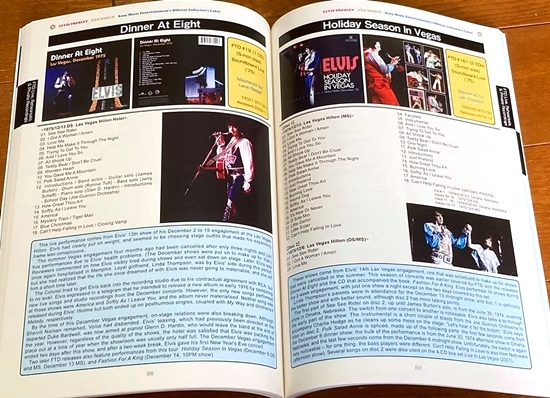
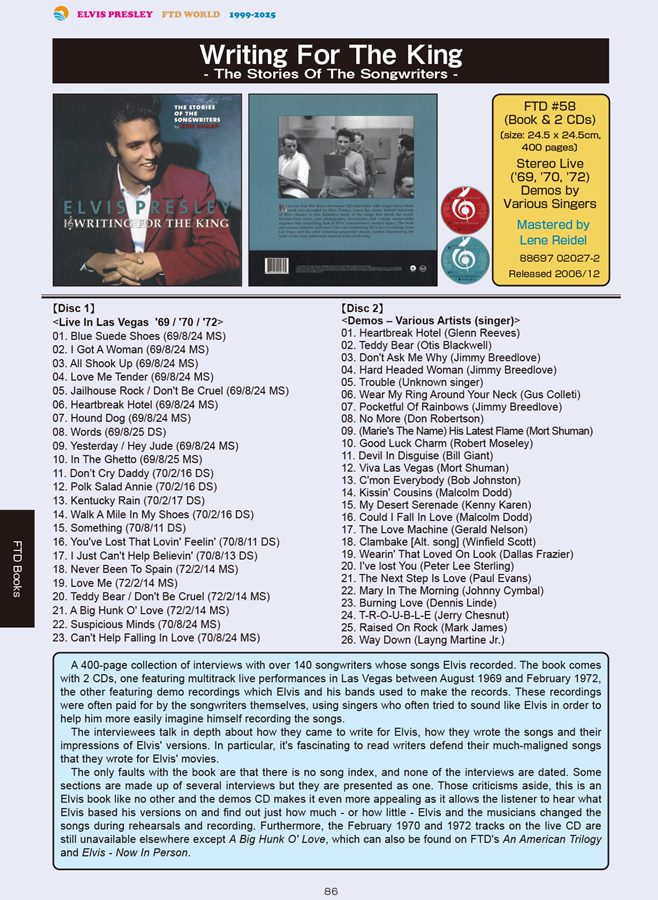
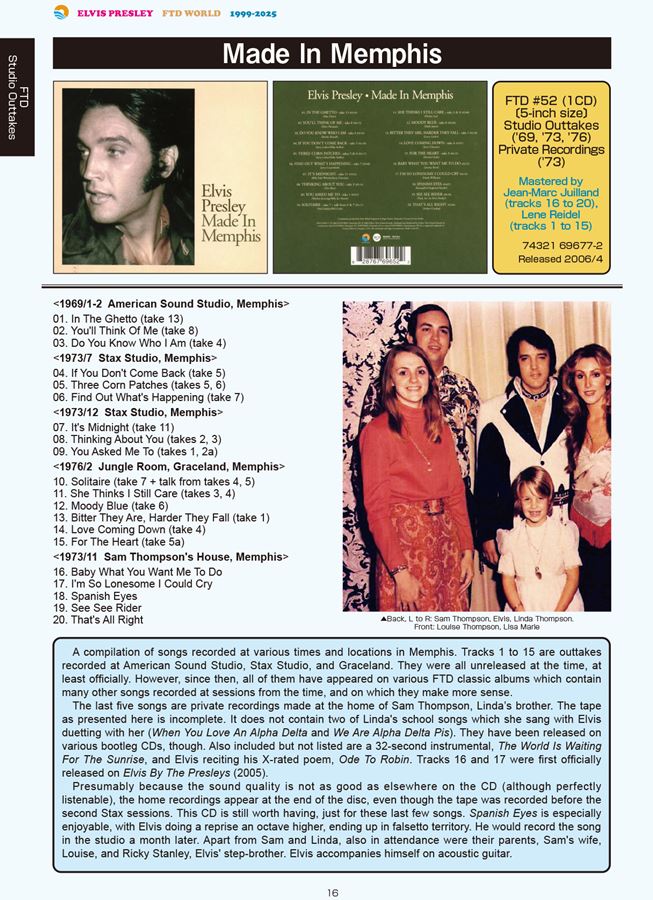
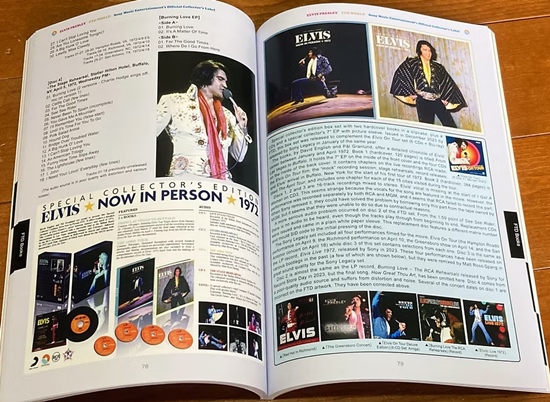
A new 2-volume book (152 pages each) from David Ward & Atsushi Nakamura covering all the FTD releases until now will be published before Christmas 2025. Vol 1: FTD Studio Outtakes - FTD Live, Rehearsals, and Private Recordings - FTD Classic Albums
Vol 2: FTD Soundtracks, FTD Books, FTD Sessions, and FTD Records
The publicity states...
..In 1999 a new label, FTD (Follow That Dream), was founded for avid Elvis fans who wanted more than just official releases. FTD releases were available through fan clubs and Elvis dealers around the world, and were extremely well-received from the start. The variety of releases gradually expanded to include not only CDs & Vinyl, books and sets.
We have compiled all 281 FTD titles in these two books, from Burbank 68, released in 1999, to the most recent, Good Times – The Outtakes Ocean Blue Limited Edition in 2025.
EIN: Hi David, thanks for agreeing to this interview about your new publication. While your youtube video explained a lot - see below - there are still some questions that I think fans will be interested in.
David Ward: Hi, Piers. I think we've been here before. Sure - fire away.
EIN: You have published several books about Elvis’ association with Japan, I think the most recent one being the very impressive Aloha Through The Eyes Of Japan. What inspired you to produce a book about the FTD label?
DW: The Aloha book was published by the Elvis Presley Society of Japan. I just translated it. Anyway, through writing my Japanese discography, From Memphis to Tokyo, I met Atsushi Nakamura. He gave me a couple of Japanese books he'd written on the FTD releases up to 2021.
I was impressed with the layout and thought there'd be a lot of interest in an English version. Nothing happened for a while, but my friend, Adam Greenaway, kept nudging me as he was very enthusiastic about the project, so I decided to press ahead with it.
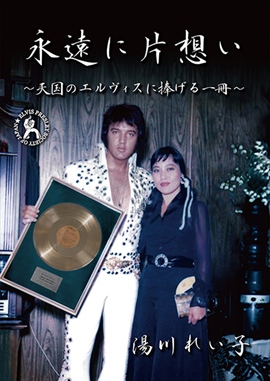
Atsushi has been working on another Elvis-related project, editing a book by Yukawa Reiko, a famous music critic who's always championed Elvis and his music in Japan. It's coming out in January, but it'll only be available in Japanese, I'm afraid.
EIN: That is a fabulous looking front cover! With the FTD book both you and Atsushi Nakamura are co-authors. How did you work as a team, who was the driving force?
DW: Well, we've had very different roles. I basically translated some of Atsushi's work, added my own input to some pages, and wrote new pages for all the post-2021 FTD releases. Atsushi was responsible for the layout and made some great suggestions regarding content.
He also spent quite a bit of time colourising some of the old black and white photos. They've come out really well. We've both been equally diligent when it comes to checking and rechecking what's in the book.
EIN: I had noticed the neatly colourised photo of Elvis and Ann-Margret at the Old Vegas Amusement Park, it looks great. So what made you think that this was the right time to publish your book about FTD?
DW: Inspiration. I got the bit between my teeth and just went for it. Fortunately, Atsushi was really great to work with. There was never a time when I sat around waiting for him to do something.
EIN: I can imagine that 2027 might be a good year for the FTD label to wrap up. Did you think about waiting another three years to publish the set or do you think the FTD might continue for a bit longer?
DW: Never thought about that for a moment. I think FTD will continue until 2035. That will be the big 100, of course. It would make a lot of sense to call it a day then. I'm nearly 60 and I think my generation is now the largest group of Elvis fans - the offspring of the original fans, if you like. By 2035, we'll be retiring and starting to wind down our collecting activities, maybe even downsizing our collections. There are younger fans, as you know, but probably not enough to sustain a project like FTD. Besides, there's the elephant in the room - how much material do they actually have left?
EIN: (laughing) There was a very impressive three volume set called ‘The World Of FTD’ published back in 2017. Ok, I was a co-author! How does your book compare?
DW: Yes, well done to you guys. The World of FTD was a great achievement. Our set is obviously much smaller in terms of pages but it's much more affordable as a result. We don't include any full-length reviews, although we have inserted our own thoughts on many of the releases throughout the book. Hopefully, there are some stories in there about Elvis that many fans won't know. There are also things common to both books, such as track listings (corrected, where necessary), release dates, and other basic information about each FTD release and the recordings on them.
One noticeable difference is we have organised the books by the different types of FTD release (outtakes, live releases, classic albums, etc.) and each section is organised chronologically according to when the music was recorded, not when it was first released. This makes a lot of sense, in particular, with the live section. It also means that the soundtrack albums, classic albums, and LPs mostly appear in the order they were released in Elvis' lifetime. And our books go right up to the end of 2025. There have been almost 80 FTD releases since 2018! We can only hope that we actually do see the Good Times blue vinyl LP and The Making of G.I. Blues this year, because they're both in Volume 2.
click for high-res
EIN: Did you contact Roger and Ernst to discuss your book? Have you got any feedback from them?
DW: No. I'm sure they're both very busy guys who don't need the hassle. We'd rather leave them to focus on bringing us new FTD releases. And if they ever want to do How Victor Brought Elvis to Japan, we'd love it if they got in touch. We're both big fans of the book, How RCA Brought Elvis to Europe.
EIN: When I met Roger and Ernst back in 2002 there was a discussion back then about them setting up their own FTD website, but it never happened. Do you think this was a failure on their part?
DW: From a fan's point of view, it would have been very appealing, but for them it would have been very time-consuming and I'm not sure how beneficial it would have been from a commercial standpoint, given their products are not sold in regular retail outlets.
EIN: You start the book with a section on ‘studio outtakes’. Did you not consider kicking off the book with Elvis’ Live performances seeing how the first FTD release was Burbank 68?
DW: I never asked Atsushi why he started his Japanese books with the outtakes but, thinking about it now, it makes sense the way we've done it, as the live section contains music almost exclusively from the latter part of Elvis' career, whereas the outtakes section is mainly made up of 1960s material.
EIN: It is fascinating to see the FTD legacy go from the early days of single CD compilations, to double CD ‘Classic Albums’ and eventually to 4-CD sets of live soundboards and “complete” studio sessions. Do you have any idea of the varying print numbers over the years?
DW: Not really, no. There is some speculation out there regarding print numbers of some titles, but I didn't see the point in going there, although obviously we mention it in the case of numbered, limited editions. I think the bigger FTD releases of recent years were inevitable. After the Classic Album series was done, what could they do but gather up all the unreleased scraps and release them with all the complete takes as sessions boxes? After they'd issued the best concerts, what could they do but bundle a load of lesser performances onto one multi-disc set?
Again, they know most of their customers are people like me, older guys (and a few girls) who grew up buying physical media. I'm not complaining, though. The sound and the packaging have improved, all the concerts are fascinating in their own way, and the sessions sets are fabulous. The books are also generally of a very high standard and the artwork on the LPs is stunning.
EIN: I noticed that with 'Dixieland Delight' you note that there was a Praytome Publishing book that was supposed to be released as a tie-in, but never happened. Do you similarly mention all the FTD reprints and any differences between the reprints?
DW: We mention all the reprints we are aware of, which is quite a lot and yes, we point out the differences. I thought it was important not to get bogged down with things like that, though. Obviously, we mention really glaring errors, like getting Elvis' surname wrong twice on the Wild in the Country classic album covers, but I think it gets tiresome to read about every tiny speeling mistake.
EIN: Talking of which, I was astonished by the popularity of Elvis 1977 ‘The Last Tours’ releases. FTD were obviously similarly surprised as they had to do a reprint of Vol.1 immediately. What do you think about Elvis fans' fascination with his rather sad final year?
DW: That's a really complicated issue. I don't think it's just fans. When Elvis died, his record sales shot through the roof, and it wasn't just fans doing it out of loyalty. I think it's a perfectly natural reaction for fans to be fascinated with Elvis' last year. It reminds me of an old Byrds song which has the line, "You don't miss your water till your well runs dry." Of course, the public have gotten over Elvis' death but for us fans it still stirs up complicated emotions. It's as though, by buying his records when he died, or by snapping up The Last Tours, we're trying to get a part of him back in some way. I think people also often dwell on the past, quite naturally, and think about what might have been. With Elvis, we know it could have been very different. I think there's enough subject matter there for a whole book. To be written by someone cleverer than me.
EIN: Wow, there's another book you do need to write! :-) A few FTD releases have had some technical issues with their mastering and also incorrect tape speed. Do you make note of these issues?
DW: Certainly. The tape speed issue is my biggest complaint with FTD releases, but the problem is not as bad as some make out. There are two or three FTD live releases I can't listen to because they're either noticeably fast or slow. But when people go on about a release being 1% fast or 1% slow, I switch off. No one can hear that. Many people can't even hear it when it's 2% out. I'm interested in what my ears are telling me, not what computer software is showing me. It is frustrating, though, because MRS corrects these speed issues when they release a concert already put out by FTD. It must be something to do with money.
EIN: Have you included extra photos or are they all taken from the FTD releases?
DW: Yes. Erik Lorentzen very kindly allowed us to use some of his splendid photos. While the pictures compliment the release in question, we only used photos when we could. There are, of course, photos of the actual FTD releases.
EIN: What do you think will be the highlight of your book for FTD collectors?
DW: I can't exactly complain about big books, given the size of From Memphis to Tokyo, but I do think fans will welcome how reader-friendly they are. They offer a quick and easy way to see what's out there, what each release is about, and what you're missing. Hopefully, the info we provide will help people decide whether to fill in the gaps in their collections because many FTD releases are quite expensive now on the used market.
The concert data section at the back of the book is also a great way to see which tours and Vegas / Tahoe residencies FTD have covered and which ones they haven't. We also have a couple of surprise sections featuring contributions from two people who are very much involved with FTD releases. We're very grateful they gave us their time.
EIN: Do you buy every FTD vinyl release and every book? What is your personal priority as a collector?
DW: I don't buy every release, no. However, Atsushi has nearly all of them, so I've had access to most of the ones I don't have. For me, the music is the most important part, so the concert CDs and sessions box sets are automatic purchases.
EIN: I purchased every FTD release until they started producing the huge deluxe coffee-table books. Unfortunately living in Australia the overseas postage for the large books is now around AU$100 = US$65 which is a lot extra on top of the European price. Is this an issue for you in Japan?
And might this be a reason for you printing soft-cover versions of your book?
DW: The reason for publishing two soft-cover books, as opposed to one hardback volume, was printing costs. We also had to keep in mind that most people buying the books would be in Europe. As you say, shipping books overseas is not cheap. To answer your first question, if I were an FTD book collector, shipping costs would be an issue, yes. Personally, I prefer text-heavy books such as Writing for the King rather than books with lots of photos. Fortunately, they tend to be a bit lighter than the big coffee-table books.
click for high-res
EIN: When are you hoping for these to be ready for posting, will they make it in time for Christmas?
DW: We are hoping to receive the books on December 8. We'll be sending them out immediately. After that, it's down to the world's postal services and Santa Claus. Will they make it in time for Christmas? To be honest, I'd say if you are lucky enough to get the books by the 25th, you'll know the Lord's been good to you. On a snowy Christmas night. And if you don't, then give thanks for all that you've been blessed with. And hold your loved ones tight. (I think it's time to get the Christmas albums out.)
EIN: That is a truly delightful way to end. I wish you the very best for a Japanese 'Winter Wonderland' and I'm really looking forward to the new book.
Go here to Elvis 'FTD World' to order.
Priced at £35.00 (approx. €39.00, USD $47.00) + International shipping and handling
Also check your local Elvis dealers such as The Elvis Shop London, Elvis-Matters, 'Elvis 4 Sale', Elvis Presley Society (Belgium),
The books are divided into seven sections: Studio Outtakes (16 titles); Live, Rehearsals, and Private Recordings (87); Classic Albums (40); Soundtracks (31); Books (40); Sessions (16); and Records (52).
Both books contain many beautiful photographs related to their respective titles.
Check this neat YouTube trailer where David Ward explains even more....
(Interview) Dick Dekker and David Ward, authors of the new book, ‘From Memphis To Tokyo – A Reference Guide To The Absolute Mastery of Elvis’ Japanese Vinyl’: With the release of this book imminent, EIN’s Nigel Patterson and Elvis Day By Day’s Kees Mouwen, went treasure hunting in the land of the rising sun to discover what gems can be found in Dick Dekker and David Ward’s new discography about Elvis’ Japanese vinyl (and learning a few new Japanese words in the process).
Discover the delight of Japanese Elvis vinyl...
... The authors discuss the love the Japanese producers put into their releases. Making alternate, high quality and adoring covers for their records, that fascinate Elvis vinyl collectors.
... Virtually every record has something about it that’s different to the equivalent release in another country, whether it be different artwork, different songs or extras like a lyric sheet. That’s what makes the Japanese releases interesting objects for both Elvis and vinyl collectors... Read Dick and David’s fascinating interview
(Interview, Source: EIN/EDBD)
Book Review 'From Elvis in Japan': David Ward's 'From Elvis in Japan: Elvis Presley Japanese LPs 1956-2018' is the a very detailed and visually attractive Elvis “discography”. It covers Elvis LP (vinyl) releases in Japan between 1956 and 2018, the e-book is full of interesting information about each release and stunning images of the LP covers and discs.
The discography contains information on 131 Elvis LPs released in the “land of the rising sun”, a complete song index, and “value add” sections such as How to Read Elvis’ Name in Japanese, Japanese Albums with US Artwork, and English Lyrics (the translations are often outrageously funny!).
Japan also pressed plenty of unique compilations such as 'Elvis Presley Special 24', 'Elvis on Screen', 'Elvis Presley The Complete Singles (11 LP box set)' and 'Elvis Presley By Request of Japanese Fans'.
In a fascinating and entertaining interview with EIN’s Nigel Patterson, David discusses: - the extra effort RCA Japan put into Elvis’ LP releases
rare albums
- what you can find in Japanese obi strips on Elvis LPs
- the Elvis LP obi strip doubling as a poster
- Elvis’ record sales in Japan
- the single you need to hold up to the light
- some very funny Japanese transcriptions of English lyrics, and a lot more.
There is also a shout out to Ernst Jorgensen!