|
 |













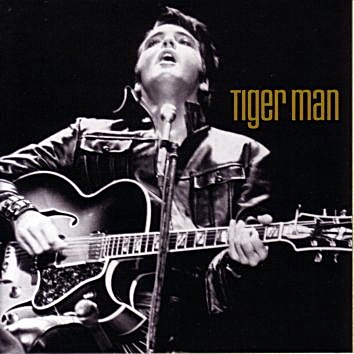
When I was a teenager I had three Elvis albums, Elvis: Comeback Special, Arcade's 'Elvis 40 Greatest Hits' and the UK released 'Elvis Presley The Sun Collection' - at the time I thought that was all the Elvis music I needed and it probably encapsulated everything I needed to know. But like all fascinating topics, once I started digging into Elvis' amazing legacy I discovered that there was so much more to explore. And that is the joy of being an Elvis Presley fan because there are so many aspects to his legacy and so many different facets to be interested in. There are Elvis’ 50s recordings, TV appearances, his movies, the army years, his gospel music, the glory of his 'return to splendour' live performances, his airplanes, even his jumpsuits! There is always so much to be explored and to learn. But of course none of these would have happened without Elvis walking into the Memphis Recording Service in mid-1953. And it is his crucial five SUN singles that would not only be the bedrock of his stunning legacy but the music on those fragile pieces of shellac would also go on to change the history of rock 'n' roll. They would even change the world of popular entertainment. From my first purchase of that Sun Collection album and then reading Colin Escott's excellent 'Good Rockin' Tonight: Sun Records and the Birth of Rock 'n' Roll' I became more and more fascinated about Elvis' creative work with Sam Phillips.
The perfect quote from Sam Phillips
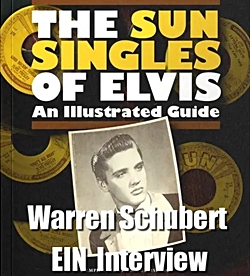
Having first come across David Petrelle's 'Solid Gold Elvis' discography and then all the 'Elvis UK' books by John Townson and Gordon Minto, I then became intrigued by incredible number of permutations of every Elvis release. And let me state that the topic interests me even though I am surprisingly not a hard-core vinyl collector! Sadly my vinyl collection was stolen decades ago and so now I tend to only purchase vinyl that I will play - and never multiple copies. Having said that, the idea that an author could write a 230-page book dedicated to those special Elvis SUN releases fascinated me and 'The Sun Singles of Elvis – An Illustrated Guide' truly is an incredible journey.
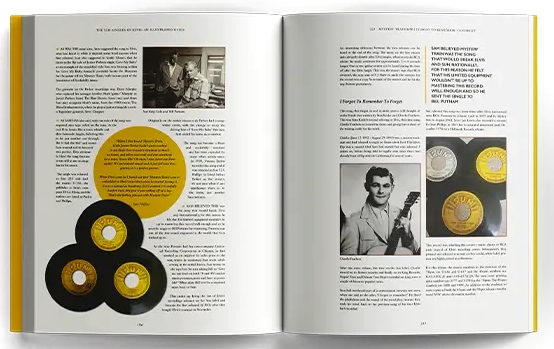
The book, published by Memphis Mansion, is written by Warren Schubert, with the tasteful ‘Sun-coloured’ layout and design by Søren Karstensen. The multiple pages of vinyl-scans highlight all the details of those old crackly Sun records. The detailed foreword by ‘Sun Records Collector and Obsessionist’ Mack Stevens provides a great introduction about why these records are so important to collectors. He also makes the great point about what might have happened if any of the previous Sun singles before ‘That’s All Right’ had been a massive hit.
The chapters of the book include.. - A New Beginning For Sun And Elvis
- Publicity
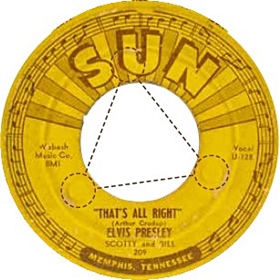
- Label Production These are followed by a detailed chapter on each Sun single starting with the record that changed everything… - Sun 209: That’s All Right B/W Blue Moon Of Kentucky As an interesting comparison I referred back to my 2002 copy of 'Solid Gold Elvis' to check the previous known information. It stated ... 'SUN 209 – For both 45rpm and 78rpm - Memphis pressing or Monarch pressing - White sleeve, Three label Variations' - Schubert's book sure clarifies just how wrong that information was! As Schubert explains..
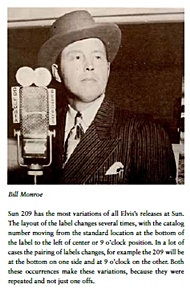
The chapter on Sun 209 runs for 50 pages and features twelve 45rpm variations plus six 78rpm variations (as well as a couple of anomalies) all carefully presented on a full-page. In his interview with EIN the author noted that he personally owned.. "Four copies of the 78rpm with one having a large chip taken out and one I bought that is in four pieces having been dropped. I own nine copies of the 45rpm, one has a misplaced label. Another one has the 'That's All Right' label on both sides, however the two labels are from different printing batches. I have the upside down 209, I have what I consider the first pressing, the one containing the word "with" above Scotty and Bill and each of my copies is some variation and all were used in the book."
Click for high-res image
While the change of each detail is explained and noted, what is missing from the book is an index that lists of all these variations. With so many SUN label variations within the book I lost my place a few times. There is also the interesting follow-up...
- Sun 210: Good Rockin’ Tonight B/W I Don’t Care If The Sun Don’t Shine The final chapters look at the Sales Figures as well as a ‘Real Or Reproduction’ which helps fans spot any fakes and there are plenty of old fakes from 73 and 78 selling on Ebay. I found every chapter contained some fascinating new information that added more to my understanding about these key Sun singles. And there is far more to discover than just the examination of each variation of single.
His look at ‘The Publishing Acknowledgements’ is also another informative chapter providing detailed information on the various Publishers that are always noted on the record labels such as ASCAP and BMI. I was interested to read about ‘Hi-Lo Music’ since four of Elvis’ ten songs released on Sun were covered by Hi-Lo Music which was in fact Sam Phillips publishing company. And what a joy to discover that Elvis’ contract with Hill and Range publishing was actually signed by Elvis and his parents - without the involvement of Parker!
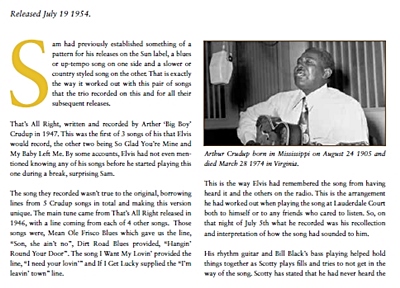
The chapter on each single also looks in detail at how Elvis came to record these classic songs and where he drew his inspiration from. For instance the extraordinary comparison between the original artists behind the two sides of Elvis’ first single truly demonstrates how Elvis was creating something magical from “all kinds of music”..
The chapter about my personal favourite, SUN 223 Mystery Train B/W I Forgot To Remember To Forget includes some lovely insights ..
The book’s examination of Elvis’ musical influences as well as Sam Phillips recording choices is also appealing and corrected some of my SUN mistaken recollections. Such as, why did I not remember anything about Sun studio house band 'The Snearly Ranch Boys' which included Stan Kesler? And I always believed Mack David’s ‘I Don’t Care If The Sun Don’t Shine’ was in the Disney film Cinderella but in fact it didn’t make the final cut.
The book also includes this interesting RCA 'Record Prevue' I have never seen before
As noted earlier, the book would benefit from an index of all the single variations and pressings and I would have loved some more photos of Elvis that referenced each stage of his SUN career.
Overall Verdict: While this book might possibly be considered for ‘serious vinyl collectors only’ it also includes a lot of fascinating, new information. Schubert’s book not only beautifully presents every Elvis SUN release with pages of label variations and vinyl details but he also captures all the hard work that Sam Phillips and Marion Keisker had to do behind the scene to enable Elvis to become the world’s greatest music icon. Go HERE to Memphis Mansion shop to order the book If you live in the USA you can save on O/S postage and buy a copy direct from the author
EIN Website content © Copyright the Elvis Information Network.
Elvis Presley, Elvis and Graceland are trademarks of Elvis Presley Enterprises. The Elvis Information Network has been running since 1986 and is an EPE officially recognised Elvis fan club.
|
|