 |
'Elvis Dressed to Rock' from Weldon Owen publishers came out in August 2026
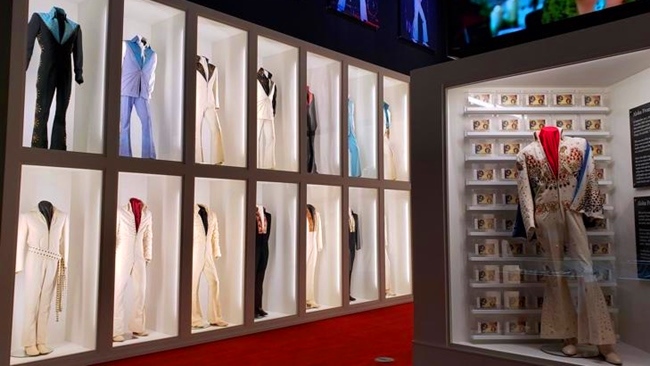
The book features more than 150 pieces from across Elvis' career: the gold lamé suit, the black leather of the 1968 Comeback Special, the caped jumpsuit from Aloha from Hawaii and the last jumpsuit he wore on stage, in Indianapolis.
Every piece is shown in new photography, from capes, belts and studded boots to jewellery and chokers made for him but never worn. Some outfits appear as complete sets for the first time, including three Cisco Kid suits from Las Vegas in 1971 and two Dude Suits from 1972, alongside rare sketches by costume designer Bill Belew and images of Elvis wearing them on stage.
The author Karan Feder is a leading expert in the field of performance costume history, preservation, and exhibition. She is an experienced museum professional with expertise in the development and execution of compelling costume and fashion exhibitions.
Karan Feder kindly agreed to answer some important questions about her very stylish book.
|
EIN: Hi Karan, I was super-impressed with your recent ‘Elvis: Dressed To Rock’ publication and it’s great to have a chance to ask you a few questions.
Firstly can I ask, where did you grow up, were you an Elvis fan as a child and how did you come to be known as a ‘costume historian’?
Karan F: I grew up in the Midwest US and moved to Southern California to start my professional career working as a costume designer in Hollywood. A subsequent move to Las Vegas, Nevada, prompted my interest in archival costume collections in response to the state’s failure to actively identify, preserve, conserve, and interpret the stage costumes that helped establish Las Vegas as “The Entertainment Capital of the World.” I was keen to remedy this negligence and founded Entertainment Exhibitions, a business dedicated to the preservation, interpretation, and exhibition of performance costumes. Locally, I consult for The Mob Museum and David Copperfield’s Museum and Library of the Conjuring Arts. I served as the guest curator of costume and textiles at the Nevada State Museum for many years and when the Liberace Museum was still open, I was very involved with that spectacular costume collection.
EIN: Your previous books have been on Marilyn Monroe, the Las Vegas Folies Bergere, and, neatly trying up with the movie, a book on Barbie fashion. What led you to writing a book on Elvis fashion? Did you call Graceland and suggest it or did they commission it from you?
Graceland was eager to develop a catalog in support of its semi-permanent exhibit titled “Elvis: Dressed to Rock.” Because of my expertise in the study of performance costumes, my publisher presented this opportunity to me. I proposed a narrative that interpreted Elvis’s stage wear between 1968 and 1977 in historical context and from my unique perspective as a costume historian. This was a novel concept and a void in the entertainer’s bibliography. The team approved of this approach and I got the gig!
EIN: The ‘Elvis Dressed To Rock’ exhibition opened in 2022. How long did it take you to finish the book?
I began work on Elvis: Dressed to Rock in 2023. The book was released in August 2026.
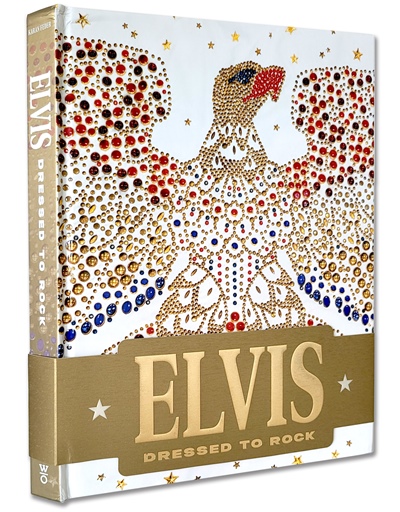
EIN: I love the front cover of your book with the lovely embossed American Eagle and the gold “Elvis belt” wrap-around. Was that your idea?
I love the book’s belt! There is a super-talented team behind me at Weldon Owen and Insight Editions. They deserve the credit for the belt concept!
EIN: Fans may be interested in your background with the Liberace museum in Las Vegas. How did you get involved with that? For you is it only about the style?
After relocating to Las Vegas, one of the first touristy things I embarked upon was a visit to the Liberace Museum. My early professional work with the famed costume designer Bob Mackie, informed my understanding of the significance of Liberace’s unique stage wear. While Liberace’s stage wear was not created by Mackie, the Liberace costumes perfectly represented the cabaret genre, and importantly, the American cabaret genre. Following my visit to the Museum, I expressed concern for the preservation of this collection and volunteered to assist with the establishment of industry best practices.
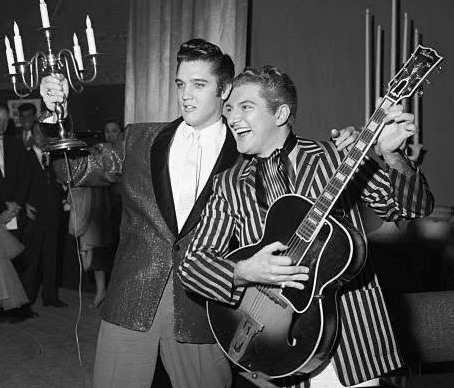
EIN: Do you think Elvis was influenced by seeing Liberace perform in Las Vegas?
I believe Elvis did respect Liberace’s success and showmanship. The key point is that the Colonel was so taken with Liberace’s stage style that he commissioned a metallic gold costume inspired by Liberace for his young client.
EIN: While the main focus of your book is on Elvis’ later jumpsuits I think the chapters discussing Elvis’ earlier 50s and 60s fashion is important. How on earth did you decide how much of the book to dedicate to pre 1969?
Elvis: Dressed to Rock showcases the costume design of Bill Belew for Elvis Presley between 1968 and 1977. To understand the significance of the professional relationship between Elvis and Belew, it’s interesting to examine Presley’s stage style before they met. Although my publication does briefly juxtapose Elvis’s 1950s stage wear with Belew’s visionary design for Presley, the book’s primary narrative is focused on the cultural significance of Elvis’s stage wear during the final chapter of his career.
EIN: It seems a lucky coincidence that designer Bill Belew was working for the NBC wardrobe department when Steve Binder began production on the ‘Comeback Special’. It’s obvious that Elvis found a real affinity with Belew’s style. How much input do you think Elvis had into Belew’s designs?
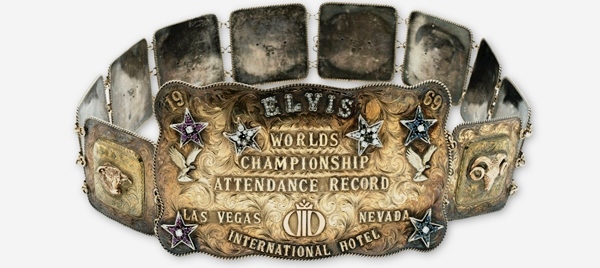
Like all successful partnerships between costume designer and performer, the relationship is one of mutual respect and collaboration. As an example, the iconic Championship Belt, received in acknowledgement of Elvis’s audience-attendance record achieved during the 1969 season at the International Hotel, was a prized and go-to accessory for Elvis. Presley was quick to style the belt with various onstage and offstage outfits. Although the Championship Belt was not created by Bill Belew, its use as a stage wear component was likely sanctioned by the designer. The bedazzled and theatrical belt effectively captured audience attention, directed audience gaze, and amplified Elvis’s signature stage movements.
Realizing the significance of this accessory to Elvis’s stage style, Belew’s subsequent belt designs for Presley reflected the silhouette of the original trophy belt. Belew’s belt designs for Presley before the arrival of the Championship Belt were of the soft, sash style that loosely tied at the hip. This pivot demonstrates Belew’s flexibility to adapt design concepts to better align with the desires of the performing artist.
 |
EIN: Bill Belew worked with some other well-known names such as Gene Doucette and Ciro Romano. Do you think they work together as a team, all having input to the final designs, or were their jobs separate?
Doucette and Romano played integral supporting roles in Belew’s work for Elvis. Ciro Romano was employed as a tailor at the Ice Capades studio and was responsible for interpreting Bill Belew’s design renderings and drafting the patterns to achieve the design. Romano supervised construction of Elvis’s wardrobe and he likely would have been present during the final fittings of the costumes. Gene Doucette is credited with the design of the surface decoration on much of Elvis’s stage wear. The seamless professional collaboration between Belew, Romano, Doucette, and Presley continued until Elvis’s passing.
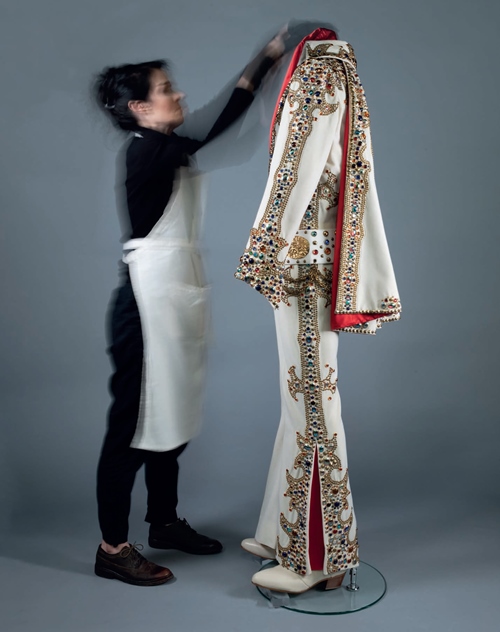
EIN: I love the photo in the book of you getting Elvis’ ‘King Of Spades’ suit ready for its close-up. How long did it take to photograph every suit and how long were you at Graceland itself?
Our team spent a week at Graceland. The photography sessions were labor and time intensive as nearly every costume photographed required removal from the exhibition gallery for transport to our photography studio in a different building on the Graceland campus. Upon arrival of each dressed mannequin, we styled the costume and positioned the mannequin for our various shots. Once the shots were completed, the costume/mannequin was returned to the “Elvis: Dressed to Rock” exhibition gallery.
EIN: With Elvis’ later jumpsuits there was so much intricate embroidery and gem-stone work that looking closely at all the detail and stitching is quite overwhelming. Luckily the ‘Direct From Graceland’ exhibition in Australia had nothing between fans and the jump-suits. What was it like for you seeing the suits that close?
I was impressed with the overall condition of the decorative elements. There was minimal element loss and the embroidery work was still vibrant and devoid of abrasion. This is testament to the quality of construction coming out of Ice Capades Costume Company during the 1970s.
EIN: Was there a particular suit that you felt over-awed by?
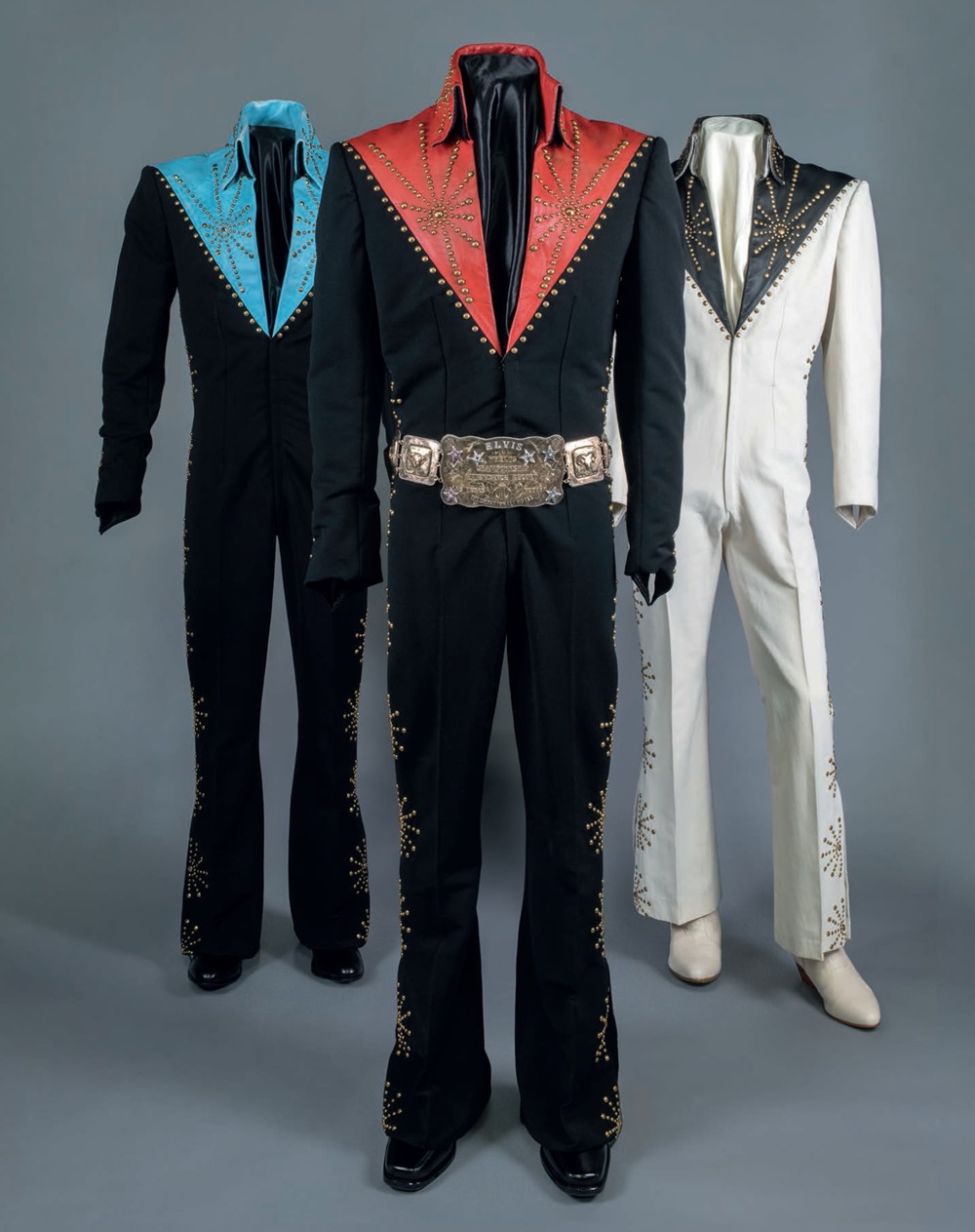
There are a handful of Presley’s stage costumes that deserve special attention, for instance: most fascinating, most unusual, most historically significant, most visually effective, and most underrated. The Cisco Kid Jumpsuit series gets my vote for most visually effective costumes.
(click image above for high-res version)
Costume designer Bill Belew crafted these striking jumpsuits by blending high-contrast design elements to make a bold impression that would captivate audiences both in the front row and from the farthest seats in the theater.
EIN: Is there any of Bill Belew’s designs that impressed you the most?
The American Eagle Aloha Rehearsal and Show Jumpsuits feature a unique and curious design element. These costumes are the only known jumpsuits to include extensive decorative studwork at the hipline, providing the illusion of Presley’s typical hip-hugger style belt. The allocation of resources for an embellishment that would not be visible to the audience seems an extravagant folly. Did costume designer Bill Belew suspect that Elvis might remove his belt mid-performance? Perhaps the unusual faux belt ornamentation was a preemptive attempt to rectify this possibility. This is an example of a topic that I am still intrigued by, and one I wish someone would have thought to ask Belew about when he was alive.
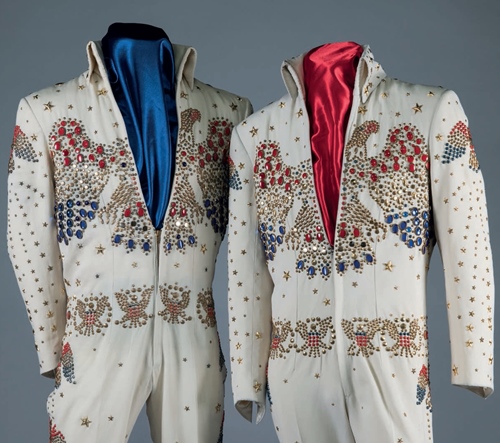 |
Page 212 of Elvis Dressed To Rock neatly explains...
.. In the photograph above, the American Eagle Rehearsal Jumpsuit is pictured at left and the Show Jumpsuit at right. These jumpsuits are nearly identical, but there are slight ornamental differences to be discovered in the stud placements.
At the hipline and to the immediate left of the front zipper placket, a five-stud curve is present on the Show Jumpsuit, while in the same area of the Rehearsal Jumpsuit, just a single stud is seen.
A careful side-by-side examination of the two costumes reveals additional slight differences in the placement of the star-shaped studs.
EIN: Your comparison of the two different Aloha jumpsuits in the book is fascinating. These suits are over 50 years old and some Elvis wore multiple times while doing some physical sweaty on-stage work outs. Have they been repaired and did you notice the wear on some of the suits?
To my eye, the most visually distracting condition issues are the areas where the gabardine textile is puckering against the seaming. I suspect these problem areas resulted during cleaning when the gabardine and the seaming thread reacted differently to the employed cleaning agents.
EIN: While the “new romantic” pop-movement was starting in the late 70s I personally think that Elvis’ Egyptian Bird bishop-sleeves suits he wore in 1976 did him no favour. Even the Gypsy suit would have looked better without those sleeves. What do you think influenced these designs?
When we consider Elvis’s stage wear in historical context, that is, during the Vegas era, Presley’s stage style was very much a reflection of the fashionable trends of the moment.Bill Belew exaggerated these design details for the scale of a theatrical stage, but the look was rooted in accepted fashionable themes. Describing his design inspiration, costume designer Bill Belew recalled that “A lot of the things I did for Elvis in the early days were things that I and other kids were wearing at that time.” Indeed the billowy bishop sleeve was a fashionable silhouette during the mid 1970s.
EIN: Elvis wore these spectacular jumpsuits with The Osmonds then following and wearing almost identical suits. David Cassidy, Mick Jagger, Glen Campbell and others also wore similar suits at the time yet it is only Elvis that is truly identified by his jumpsuit fashion. Why do you think that is?
All the entertainers you mention survived beyond the late 1970s. Their visual evolution kept up with the culture. Of course, Elvis’s stage style evolution was abruptly terminated in 1977 and thus frozen in time.
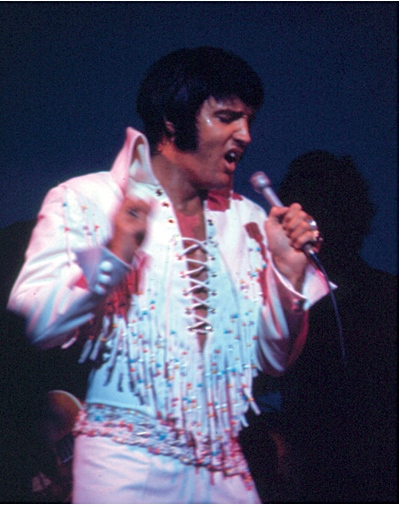
The book notes: Here, the original white macramé belt and neckline lacing of the Fringe Jumpsuit can be seen. |
EIN: I presume that you saw the recent Baz Luhrmann ‘EPiC: Elvis Presley In Concert’. What did you think of seeing these jumpsuits in action?
EPiC was a monumental undertaking and a significant gift for future generations seeking to understand Elvis’s legacy.
The film’s concert footage reinforces the brilliance of Bill Belew’s work for Elvis. I was especially impressed by the “performance” of the fringe on Elvis’s costumes, and how this design element both animated and highlighted the entertainer’s unique physical performance style.
Of course, the experience of watching Elvis perform enhances the authority of all the stage costumes.
EIN: You do have a very nice photo of Elvis' fringe suit in action in the book. Do you listen to Elvis’ music at home – or perhaps while working on the book?
Yes, I have a handful of favorites on numerous playlists!
EIN: One of the tricky topics I have to ask you about is the Graceland produced ‘The Jumpsuit Anthology’ book. Did you have any idea they were going to produce their own book at the same time? Both are EPE authorised, what’s going on?
Graceland was not forthcoming about their plans to produce a competing publication. The photos used within Graceland’s offering were simultaneously taken during our team’s scheduled and dedicated photo session at Graceland. My publisher was assured that these duplicate photos made by a Graceland-hired photographer were to be used in the institution’s internal archival database.
EIN: Graceland’s Angie Marchese wrote an introduction for your book, yet her name is not even mentioned in the ‘Graceland Archives’ book. How does this make sense?
We were thrilled that Angie Marchese was willing to directly collaborate with us during the making of Elvis: Dressed to Rock. Angie verified the copy, making a significant contribution to the book.
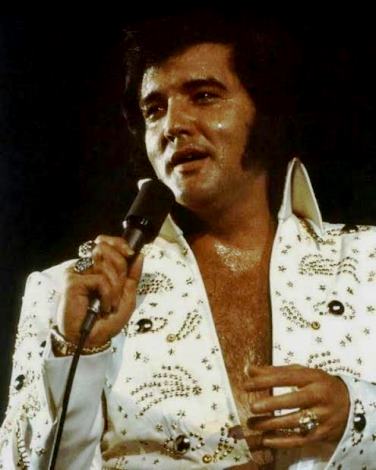
EIN believes that this is Elvis' Saturn jumpsuit - you can see the rings of Saturn!
EIN: One oddity I pointed out in my review was that the ‘Saturn’ named jumpsuit – I know that Graceland gave it the official name – is not actually the ‘Saturn’ jumpsuit which is in a private collection. I smiled when I saw that you had trouble explaining the design in your text. Were you working with Angie Marchese? Who supplied the information?
We dedicated extensive time and energy in establishing each Graceland-sanctioned costume name, in tandem with the most widely used alternate names, so that Elvis: Dressed to Rock can serve as a reference guide documenting Graceland’s official costume names, and also making sense of the sartorial terms used to describe Presley’s stage wear. This effort was executed in partnership with, and under the direction of, Angie Marchese.
EIN: Who supplied the photos of Elvis wearing the jumpsuits and did you not want to put one of him wearing every suit that you featured?
It was agreed that the majority of the stage photography in Elvis: Dressed to Rock would showcase Graceland’s archival collection. While this agreement was limiting, more importantly, we were of course constrained by the book’s page count.
We were provided access to Graceland’s photographic archive. Our team selected the archival imagery (with Graceland’s approval) featured in Elvis: Dressed to Rock.
We could have easily produced a book double the size but that was not the assignment.
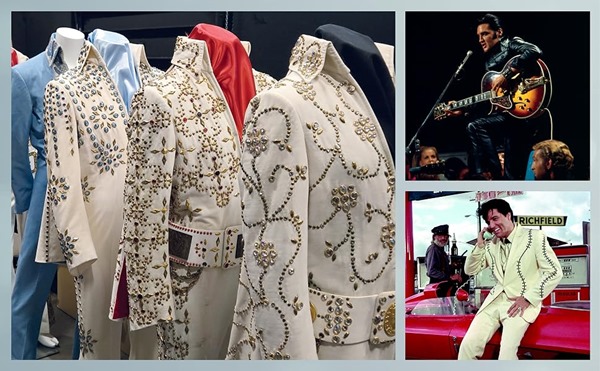
Publicity for the Elvis Dressed To Rock book
EIN: Elvis wore an extraordinary Nudie designed “cream-suit with stitching” in his movie ‘Clambake’. Unfortunately your book features the photo noting it as being a Lambert Marks designed suit from ‘Spinout’. I suspect a photo was swapped at the last minute?
This is indeed an unfortunate error. I hope the photo is credited correctly within the Graceland Archives. Lambert’s son, Eddie Marks, also worked in the Hollywood entertainment industry. It so happens that I was acquainted with Eddie, whom I met during his tenure as president of the oldest and largest costume company in the US, Western Costume Company.
EIN: Elvis often visited Hawaii and another fan of the islands was Hollywood fifties movie star Mitzi Gaynor - who stared in the Oscar wining ‘South Pacific’. She also did her own singing which I find most impressive. A little off-topic but please tell me about your connection to Mitzi Gaynor?
My very first job in Hollywood was as head of wardrobe for Mitzi Gaynor’s touring nightclub act. Mitzi’s show boasted ten male performers and over 300 costumes! The production’s costumes were designed by Bob Mackie. This experience served as a masterclass in cabaret costume design and shaped my knowledge of the essential attributes of effective and compelling theatrical dance wardrobe.
EIN: Those old Hollywood musicals were obviously hard-work and often under real pressure. In the same way Elvis made wearing his jumpsuits look so easy yet I am sure they were extremely heavy. Were you surprised by their weight and the fabric? And did the fabric get lighter in the later jumpsuits?
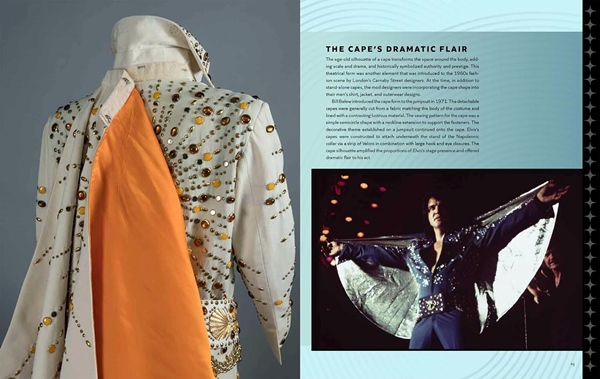
The issue of weight was greatly diminished with the introduction of machine embroidery to the surface decoration on the costumes. The capes known to have caused problems because of their weight were adorned exclusively with metal decorative elements. Of course it’s not difficult to understand why Elvis reported that the ornately studded capes were uncomfortable and cumbersome.
A look at Elvis' capes, first introduced in 1971, with details of the velcro strip and fasteners
EIN: I know that fans have been very impressed by your beautiful book. The great thing is that it’s available through Amazon and general books stores. In Australia mainstream stores such as Big W have also been selling it. How do you feel sales have been going and are you happy with the feedback from fans?
We’re thrilled with the feedback and the sales numbers. Elvis: Dressed to Rock is already in its second printing!
EIN: For someone who has spent around three years dedicated to Elvis fashion and also spending time at Graceland, do you have any message or thoughts that you’d like to pass on to Elvis fans?
The offer to study the most comprehensive collection of Elvis-worn stage costumes in the world was irresistible. The experience of making Elvis: Dressed to Rock has been a privilege and professional highlight. It’s been an honor to shine a light on the behind-the-curtain artisans responsible for stitching together the visual identity of a superstar.
EIN: Final question. Including Elvis’ Gold lame jacket, his 68 Comeback suits and his on-stage jumpsuits which one would you choose to be in your living room at home?
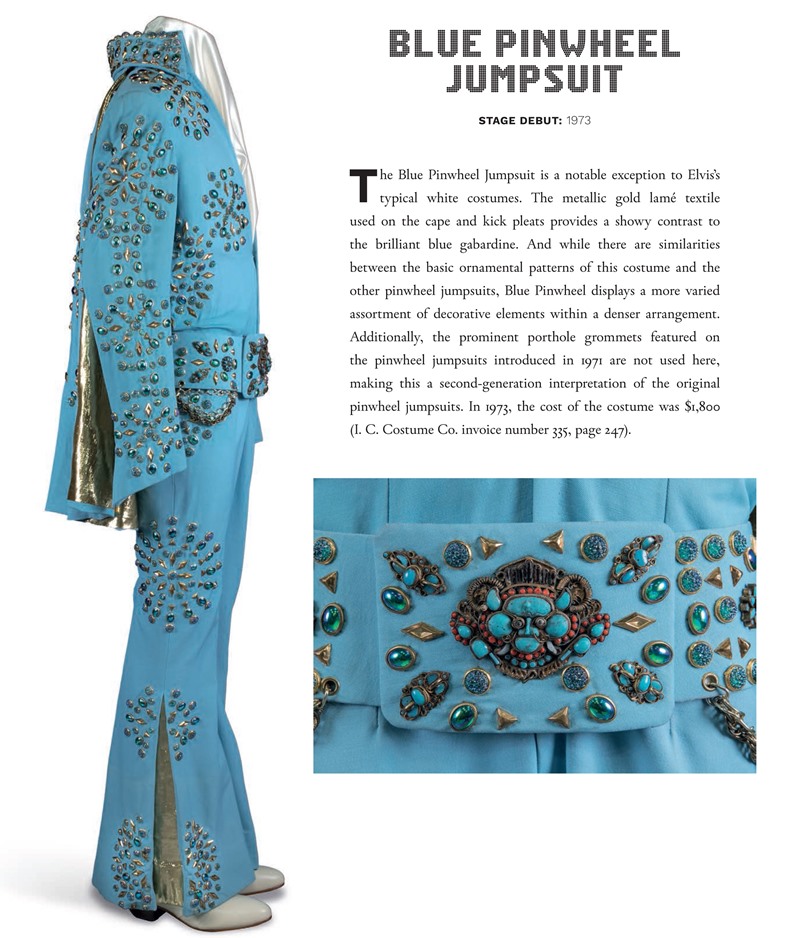
A Jumpsuit, of course, I adore Elvis’ Blue Pinwheel Jumpsuit.
EIN: Thank you so much for talking with us and I think you deserve to have Elvis’ Blue Pinwheel jumpsuit just for all the hard-work you put in to your beautiful book.
To purchase check your local book stores or go to >> Amazon US / Amazon UK / Amazon Australia
Click here to comment on this interview
Interview by Piers Beagley
-Copyright EIN, November 2026
| |
|
<click image for high-res |
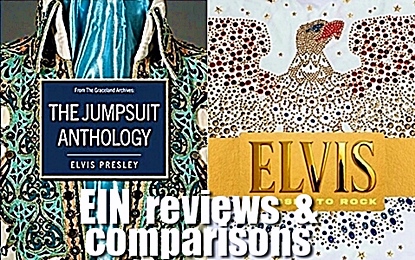
'Elvis Dressed To Rock’ vs ‘The Jumpsuit Anthology’ Book Review: It was a real surprise when in August this year, two deluxe “EPE authorised” hardback books about Elvis’ jumpsuits and fashion were released within two weeks of each other.
Both of these new ‘EPE authorised’ books 'Elvis Dressed To Rock’ and ‘The Jumpsuit Anthology’ are competing for the same market, both are extremely enjoyable in many ways as an overall look at Elvis' beautiful jumpsuits and are a delight to browse through - but unfortunately both fail to be the top-notch book that are all fans are hoping for.
What do each offer and how do they differ?
Go here as EIN's Piers Beagley compares both books against each other so that hopefully you can make the correct decision about which one to purchase.
(Book Reviews, Source;ElvisInfoNet) |
 |
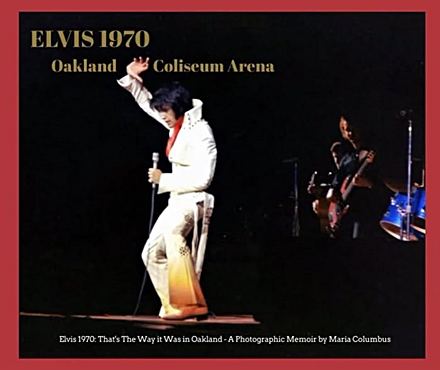
(Book review) 'Elvis 1970 Oakland Coliseum Arena' (Maria Columbus): It is always interesting to view a new book with photos of Elvis on stage captured by a fan. And this new (debut) release is by well-known and respected fan, Maria Columbus.
“Elvis 1970 Oakland Coliseum Arena” is an impressive record of Elvis’ sold-out show on November 10, 1970.
That night rocked a sold-out crowd of 14,000 screaming fans at the Oakland Coliseum Arena and Maria Columbus was there to witness it all from the second Elvis stepped into the spotlight to the final, iconic announcement, “Elvis has left the building.”
This memoir includes her impressive 90+ full-colour photos, most of them never seen before - See Amazon US
Read EIN Nigel Patterson's detailed review
(Book Review, Source:NP/ElvisInformationNetwork) |
 |
Book Review- 'ELVIS : ALOHA FROM HAWAII - Through The Eyes of Japan': The book is 200 pages and features over 300 photos by Japanese cameraman Yoshiji Kizaki, newly scanned from long-lost negatives. The book features five main chapters focusing on four 1972 Elvis appearances, November 17 1972 Evening Show, Nov 18 A/S and E/S, the Nov 20 Press Conference plus the Aloha main concert.
A lot of Kizaki's colour images are very impressive and so it is no surprise to learn that several of these photographs were used on Japanese vinyl album sleeves. There are some absolute beauties and the delight is that you will have never seen them before!
While this is obviously a photo book it is much more than that and the matching text makes it feel like a very personal journey. This book is actually about how the Japanese team witnessed some of Elvis' greatest performances and became a crucial part in Elvis' most famous live broadcast.
I have seen so few November 1972 on-stage photos before but here we get around fifty images from every concert. In ‘Elvis A Life in Music’ Ernst Jorgensen wrote “By the end of 1972 Elvis was definitely overweight” so it is a surprise that these images show Elvis looking taught and terrific. In fact several from his November 17 concert could easily be mistaken for his iconic Aloha performance!
See EIN's Piers Beagley detailed review
(Book Review, Source;ElvisInformationNetwork) |
 |
(Book Review) Elvis The King of the Rings Volume 2 (Paul Bélard): The second volume of Paul Bélard’s two volume photo-journal record of Elvis’ love of rings has been released.
While on holiday, EIN’s Nigel Patterson spent a leisurely afternoon perusing the rich narrative detail and jaw dropping, visual splendor on offer....
... They say first impressions last! The cover image of Elvis’ famous TCB ring is truly striking and sets the tone for what is an impressive examination of another 100+ rings that Elvis owned during his lifetime.
This is more than a photo-book and while the mostly colour images dominate, the narrative component contains valuable and interesting information...
This is Nigel’s detailed review- including nine stunning images from the book
(Book Review, Source: ElvisInformationNetwork) |
 |
'Strictly Elvis: 1973-74-75' Book Review: Photographer Keith Alverson's new book with Erik Lorentzen was the perfect new publication for Elvis Week 2017.
Keith Alverson first saw Elvis in concert in the early 70s when he secretly smuggled in his small pocket camera to sneak a few photos of Elvis from there he went from strength to strength. One his first Elvis' concerts where he was able to get quality photos of Elvis in concert was Elvis in Atlanta, July 1973 after which he saw Elvis over 80 times live on stage.
Alverson's outstanding photos of Elvis in his "Phoenix" jumpsuits are known by every Elvis fan. With 1,500 photos this book concentrating on Elvis from 1973-1975 has the possibilty to be a real stunner.
With the book arriving a little late in Australia EIN's Piers Beagley has at last had the chance to discover whether the book really lives up to its publicity -- Hint - It really does!
Go here to our in-depth review of this stunning book - with plenty of example pages. Now updated with reader comments including super-fan Jeanne P who saw Elvis 19 times in concert.
(Book Reviews, Source;ElvisInformationNetwork)
|
 |
EIN Website content © Copyright the Elvis Information Network.
Elvis Presley, Elvis and Graceland are trademarks of Elvis Presley Enterprises.
The Elvis Information Network has been running since 1986 and is an EPE officially recognised Elvis fan club.